In my last post, I introduced the Mediterranean Diet, which nutrition experts agree is the recommended diet to keep us healthy and decrease our risk of developing chronic illnesses such as Cardiovascular Disease, Type 2 Diabetes, some cancers and inflammatory diseases. In the next few posts, I’ll be discussing various aspects of the diet.
At the base of the diet pyramid, we see that we’re encouraged to center our meals around lots of colorful fruits and vegetables, along with legumes, nuts, seeds and grains. Let’s start our discussion with grains.
We’re all familiar with the concept of grains and I have no doubt you all know that a popular grain is wheat. But what do we know about this ancient and popular grain?
When I say that wheat is an “ancient” grain, I mean ANCIENT grain! It originated in the Fertile Crescent region in the Middle East (modern day Iraq, Syria, Turkey and Iran) and was first cultivated about 10,000 years ago. This time period is known as the Neolithic Revolution.
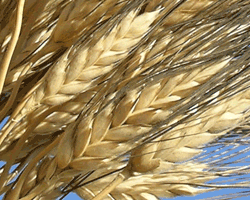
The wheat domesticated was a hybrid of three grasses and the earliest variety was Einkorn. It’s often referred to as “man’s first wheat.” It’s a husked wheat, which means it has a tough husk that tightly encloses the grain. It has a nutty flavor and it’s used in bread, pasta, cookies, pastries and in salads. Compared with other varieties, it has a lower gluten content and for that reason, is said to be easier to digest. It’s high in protein, fiber, and antioxidants compared to modern wheat varieties and yes, you can still find it in the market from specialty health food stores, online retailers and specialized suppliers. Jovial is a brand that offers many Neolithic grains such as Einkorn wheat.
Einkorn wheat berries are entire kernels of Einkorn wheat and include all the health benefits of the bran, germ, and endosperm. Consuming wheat berries is a great way to add a power-packed grain to your Mediterranean diet. Enjoy these berries cooked and thrown into a salad, cracked and boiled like porridge, or ground into fresh whole-grain Einkorn flour.
A fun way to enjoy Einkorn wheat is to mill your own flour from the wheat berries. If you don’t have a grain mill on your kitchen countertop, you can do a fairly good job with your food processor. It takes longer to grind than using a designated mill, but I run my processor for a few minutes, processing small amounts at a time, sifting and reprocessing, until I get a flour that’s fine enough to use.
Or … you can just buy Einkorn flour!
Since wheat was first cultivated 10,000 years ago in the Fertile Crescent, you may have figured out that it factored greatly in the diet of our Biblical ancestors. And you would be correct!
In the Holy Bible, wheat is mentioned over thirty times and it first appears in Genesis 30:14 when Reuben finds wheat during the days of the wheat harvest. Wheat is often a symbol of God’s provision, abundance and blessings. The phrase “finest of the wheat” symbolizes God’s best gifts.
Scripture tells us that fine wheat flour was a requirement for the “grain offering” that represented a life of dedication and thanksgiving to God.
If you’re interested in other Old Testament references to wheat, I suggest you look up:
- Genesis 30:14: Reuben finds wheat during the days of the wheat harvest.
- Genesis 41:22: Pharaoh’s dream of seven ears of wheat.
- Deuteronomy 8:8: Promised Land description.
- Judges 6:11: Gideon threshed wheat by the winepress.
- 1 Kings 5:11: Solomon gives Hiram wheat.
- Psalm 81:16 & 147:14: “Finest of the wheat” representing God’s blessing.
Wheat was an important and well-known commodity in New Testament times and Jesus used the grain in several parables and teachings. John the Baptist also mentioned wheat.
Matthew 3:12 – John the Baptist describes the Judgement using the process of clearing the threshing floor into the barn while burning the chaff.
Matthew 13:24-30 – The Wheat and the Tares (Weeds) – Jesus compares the Kingdom of Heaven to a field where an enemy sows weeds among the good wheat. He explains that both must grow together until the harvest (the End of the Age), when the righteous (wheat) will be gathered and the wicked (weeds) will be separated and burned.
John 12:24 – The Grains of Wheat – While explaining the necessity of his own death and the principle of spiritual faithfulness, Jesus says: “Unless a grain of wheat falls into the earth and dies, it remains just a grain of wheat. But if it dies, it produces much fruit.”
Luke 22:31 – Jesus warns Peter that “Satan asked for you, to sift you all like wheat” which refers to the process of testing and purification.
As you can see, wheat has been an important grain for thousands of years. We’ve cultivated it, grown and consumed it and it remains an important and healthy part of our daily diet. Our Biblical ancestors understood and appreciated its value, as did our Lord Jesus Christ.
So, when the Mediterranean Diet calls us to build our “daily bread” (yes, I did mean this as a pun), around grain, we’re doing what our ancestors have been doing since the dawn of civilization.
Next time, I’ll discuss another nutritious ancient grain mentioned in the Bible: millet!
 Marcia C McCormack, RN, BSN, PHN, FCN
Leave a comment